Dec 14, 2014 | Computer technology
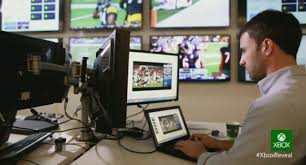
What’s the talk of the NFL sideline today? It’s not a certain quarterback’s love of a certain dirty word. In fact, the talk isn’t even about a human being. The talk is about how technology is changing NFL sidelines.
That technology is the Microsoft Surface Pro 2 Tablet, and they’re used by all 32 teams. They have to be weatherproof because, rain, sleet or snow, pro football will be played. They’re no games, no social media, no radio on these tablets. There’s simply used for coaching techniques and coaching techniques only. They’re two cameras to help make play calls. One aims at the line of scrimmage, (where a play starts) and the other shoots the whole field so coaches watch the play unfold. These images used to come out on paper printed on special printers. But with the Surface Pro 2, these images go directly to the tablet. Needless to say, this saves a ton of paperwork and waiting time for printers. Coaches can review and save images. And according to reports, the tablets did hold up the most extreme of weather conditions. And if that isn’t enough, NFL players are using RFID technology to track players and study their exact movements on the surface tab.
I’m a big NFL fan (I’m not telling you what team. I want to keep this blog civil.). And I’ve noticed these surface tablets on sidelines. Does it make games or teams any better? I can’t answer that. But I do see a concern or two. I’m definitely not a fan of RFID tracking players around, even if it is just on the field. Whose to stop them from tracking them off the field and invading their privacy? And whose to stop them from imposing that on the rest of us? So it’s good that it makes the game cleaner and run smoother, isn’t their room for improvements?

Dec 11, 2014 | Computer technology, Smartphone
You’re at a bank, entering a bar, or in any other situation where you’re asked to present your drivers licence. How would you like to present your drivers licence…on your smartphone?
In a few months, Iowa citizens can do just that. Effective sometime in early 2015, Iowa will be the first state (that I know of) to have an app on their smartphone with their official drivers license as issued by their Dept. of Transportation. Not everybody may be willing or able to make this change, so Iowa drivers can still keep their traditional plastic licenses. But DOT Director Paul Trambino assures state residents the smartphone license will be accepted at traffic stops and airports. In this era of ever increasing hacking and malware, you can protect your smartphone drivers license with a pin number. This is just one step in the Iowa DOT’s push toward embracing new technology. Other projects include camera phone on snowplows (keep in mind this is Iowa) and adding driver license kiosk centers.
I’m glad airports and traffic stops have been giving the all clear to accept the smartphone drivers licence. But what about private institutions? What about banks, bars, and stores that sell age restricted products? I hope they go on board and accept the smartphone license. Because if not, than it’s not going to do citizens much good. I think it’s great this is an optional, and not a required thing. Yes, some people are going to run to get this app, but they’re some who aren’t. Another good thing, there is no extra cost to the Iowa drivers, which is another plus. I’m not going to name the state, but I was once charged an extra thirty dollars just to get a license/state ID changed. So I must give Iowa props on that one. Do you think other states will catch onto the smartphone license?

Dec 9, 2014 | Computer technology, Wireless
The upcoming Apple Watch may be the most personal, most revolutionary tech device yet (don’t get me started on Google Glass). So naturally, Apple brings out the big guns.
By that I mean the big guns in luxury fashion. There are documents revealing that Apple is hiring interior designers with ‘a fashion or luxury background’ to help upgrade retail stores by the time of Apple’s iWatch release in early 2015. Apple is also coaching it’s own staff on luxury vocabulary for this potentially historic event. There’s a reason Apple is taking this route. There is the personalization and diverse styles of the iWatch. Apple Design VP Jony Ive even joked, “Only in prison do all people wear the same thing.” And what options do they have? You can choose between the sizes of 38 or 42mm, between stainless steel, aluminum, and here’s where the luxury comes in, 18 karat gold. Bands come in different styles and colors. Rumors have it the iWatch prices will start at $350. But the ones in 18 karat gold could easily go into the thousands. As far as we know, the exact date of Apple’s iWatch releases is unknown.
They must be expecting big things from the Apple Watch to go all out like this. And it could help. Appearance is a part of the sale, and if you can hire the best, why not go for it? But they shouldn’t forget the most important thing here: the quality of the iWatch. By quality, I mean does it function correctly? Does the fitness tracker rate your heart properly? If I send a message through iWatch, will the recipient receive it? If I go to the store and pay through Apple Pay, will it take or will I be publicly embarrassed? ?These should be their top concerns. My great uncle once said, “I’d rather drive a Pinto that runs good than a Cadillac that just takes up space.” Well, you can have all the luxury and fashion design you want, but if the iWatch doesn’t function, you’re better off with a Timex. Are they focusing too much on look and too little on quality?

Dec 8, 2014 | Computer technology
If you’ve played video games at anytime since the 1970s, you have Ralph H. Baer to thank. This video game pioneer passed away last weekend at the age of 92.
Mr. Baer is credited for patenting and inventing the first home video game. Ralph Baer was born to a German Jewish family in 1922. He left with his family to New York City in 1938 to escape Hitler’s regime. He fought in World War 2 and after the war, Mr. Baer earned a college degree from the American Television Institute of Technology in Chicago, at a time when television what in it’s infancy. In the early 1950s, when he suggested adding games as a TV feature, his boss scorned him for such a foolish idea. Many years later, at a company called Sanders, his boss saw potential in his wild idea. In 1966, Baer and some colleagues came up with a box that would allow games to be played on TV sets. Five years later, Mr. Baer and his employer, Sanders Association, patented the first home video game system. In 1972, Magnavox ?Odyssey was born. It was the first home video game console, and it sold well over 100,000 copies that year alone. Their influence was immediate. In 1974, Atari released a more popular video game called Pong. Out of court, Odyssey became a partner with Atari in licencing this historic game. The rest is history. Ralph Bear is survived by his wife of 53 years, three children and four grandchildren.
And by the early 1980s, Atari and Colecovision became household names. By the late ’80s, Nintendo and Sega were in many a home. And today, Playstation, Xbox and Nintendo Wii are on Christmas lists all over the world. Just to think, this $90 billion a year phenomenon came from one crazy vision. It’s a vision so crazy he was often ridiculed for it. But then again, most innovations usually are before they reach massive success. What lessons can we learn from Ralph H. Baer’s legacy?

Nov 25, 2014 | Computer technology, internet
The global online populations reaches a new milestone. Now, three billion people, more than 40% of the world’s population, is online.
Internet usage has grown online 6.6 percent in 2014. In less developed countries, about 2/3 of the population has Internet access, an 3.3 percent growth in this calendar year. In fact, in the developing world, online use and access has doubled in the last five years. These numbers are compiled by the United Nations’ International Telecommunications Union, committed to improving IT systems all over the world, especially where it’s most needed. Mobile network systems worldwide are booming too. By December 31, 2014, there will be 7 billion mobile technology accounts, from phones to tablets to laptops, even the smartwatch. That’s almost to the tune of one account per every citizen in the world.? Despite these encouraging stats, there is still work to be done. In the world’s bottom 42, the 42 nations with the least Internet access, communication technology remains very foreign, especially in rural areas.
For instance, there may be 7 billion mobile technology accounts, but only because in many western developed countries, many people have two or more multiple devices at once. In case you’re wondering, the top five nations with the best IT infrastructure are Australia, New Zealand, Singapore,?Bahrain and United States. But 450 million people still have no access to any mobile web service. Many tech leaders, like Facebook’s Mark Zuckerburg, are working ceaselessly to get online access to all. Now that’s a cause that I can believe in. Being in the comfortable US, I often take for granted there are hundreds of millions who have yet to send or receive an email. They have yet to see a You Tube video. They have yet to send a Facebook post or Tweet. They may not even want to. We shouldn’t be forcing anyone to use this technology. But it should be available for all people to use. How long do you think it will be before that will happen?

Nov 16, 2014 | Computer technology, internet
After a disaster of mid-term elections for the Obama Administration, Mr. President got back in the good graces of many by announcing his support of net neutrality, keeping the Internet equally regulated. Some major corporations agree.
Believe it or not, many major corporations support net neutrality. These include Ford Motors, Visa, UPS (United Parcel Service), even Bank of America. These companies urged the FCC for fair, but strict broadband regulations. They’re not going to say it aloud. In fact, when asked, they’ve denied supporting net neutrality. But there is a corporate based advocacy group called Ad Hoc Telecommunications Users Committee. This committee met with the FCC three times. Before the visit, the committee must submit information about it. Through this, we find out Ford, Visa, UPS, and Bank of America are affiliated with this committee. We also find out all four sent representatives to such meetings: UPS sent a senior vice-president, Bank of America sent a senior vice-president, Visa sent a government relations leader and Ford sent a Washington counsel. The FCC is obligated to report the meeting subject matter. Guess what it was for these meetings? Subjects included, ‘protecting and promoting the open Internet’ and ‘terminating access monopolies’. Sounds a lot like net neutrality to me.
Why would they want to keep their support for this issue secret? The majority of Americans are for net neutrality, on both sides of the political aisle. They may have some powerful corporate executives and stockbrokers who disagree, but can’t we at least agree to disagree? I’m also aware Bank of America doesn’t exactly have the best reputation right now, especially among middle Americans. Wouldn’t coming out in support of net neutrality change that? But there is the cynic in me that asking why these mega, mega conglomerates are supporting this cause? And if they’re supporting it, should we?
