
Oct 22, 2017 | Computer technology, News
It’s been around a month since Hurricane Maria devastated Puerto Rico. So according to the latest reports, forty-nine are confirmed dead. Some speculate the death toll could be as high as 450.? Also, there are dozens are missing, and much of the island is still in the dark. But the US Virgin Islands hardly fared any better. However, AT&T claims to help, and in many ways, are helping. It’s AT&T and Maria.
Phone giant AT&T partnered with Google to bring at least some kind of Internet service. This includes text messaging, emails, and basic Internet service and computer servicing.? At first, the main goal was to establish communication between Puerto Rico locals and their relatives on the mainland. They also use Google Alphabet X’s Project Loon.
These IT support balloons can bring coverage up to 1,930 square miles. That’s over half of Puerto Rico. Soon, they hope to cover most of the island. They use LTD band 8. This works only for those using the most recent iPhones, Samsung Galaxy’s, Moto G’s, and a handful of others. This should provide connectivity during daylight hours only. Apparently, Project Loon worked before. Because last years, they used it for Peru when floods hit that nation. As of this date, AT&T claims they helped 60% of Puerto Rico get power. They also claim they helped 90% of US Virgin Islands get power again.
But some statistics would disagree with that. According to this Weather Channel report, three million are still without power. That’s about 75% of their population. So that means only 25% of locals have power back.? Furthermore, these balloons will only help those who have the newer smartphones. But what about those who have phones more basic? I’m no expert, but I would guess that would be the majority of the island’s population. I could be wrong. Look, I applaud AT&T for trying to do something. However, are these balloons the right thing for the right time?

Oct 20, 2017 | Computer technology
You need the Internet to do almost anything these days. This even includes things we take for granted today. But what if it goes down suddenly? Then there is the good hack: This gets you on the Internet.
So let’s look at computer servicing programmer legend. His name is Melvis K. Melhus. One of his clients had no Internet. But most of his work involved cutting and pasting. We all know what that simple online task is. So Melhus tried an experiment. He turned his microphone/speaker system into a modem. Then, before he continued, he told them this hack may not work. But he tried anyway.
So Melhus used his speaker system in HTML 5, then converted texts to modem tones. The speed was far slower than the client was used to. However, it took some of Python and took it to Visual Editor. Melhus wrote about this experience. He wrote how Google and Stack Overflow are vital to his success. So as you can imagine, no Internet hinders that success. It’s only then how he realizes how much cutting/pasting takes place. Also, a laptop and a jack socket can apparently cure a lot of tech ills. Who knew?
What am I getting at? Well, the IT support world is full of wonder. Today, at our computer service shop, we’re using a phone charger for data transfer. I’m proud to be part of an industry where virtually anything is possible, as long as you choose to be positive about it. But the other thing: there is a such thing as the good hack. Not all hacks have to be destructive and cause pain. In this case, it did the opposite. It probably saved a lot of people from a lot of destruction and pain. This is what computer repair should be all about. How can we save you from destruction and pain?

Oct 19, 2017 | Uncategorized
A conversation comes up in our Boston computer service shop. In fact, it comes up everywhere I go. “Where is the next Amazon headquarters going to be?”, they ask. But some say, “Bring Amazon to Massachusetts!”, big emphasis on some.
However, mayors all over the Bay State bend over backwards to bring Amazon to Massachusetts. That is to say, bring Amazon’s second headquarters to their city. For example, Worcester, MA Mayor Joseph Petty was one of the first to file an offer. In this offer, he pitched a $500 million tax break over the next 20 years. Mayor Petty also states his city’s hard working talent pool.
He’s not the only one. Lawerence, MA Dan Rivera sells his town and region, the Merrimack Valley. He believes if they put Amazon in the Lawerence area, the headquarters would have easy access to all of New England. He has a point, because two major interstates go through his town. It’s close to Boston, Providence, and close to the New Hampshire border. Then there’s New Bedford, MA, a town in south-east Massachusetts. They’re offering cheap land, a public golf course, and beautiful beaches and waterfronts. South Weymouth, MA, another south east MA town, offers a former Naval Air Space.
But we can see why so many towns here offer the world to Amazon. The town that gets their headquarters get 50,000 jobs. And we’re not talking minimum wage, either. The average salary will be $100,000 a year. Furthermore, Amazon promises to invest $5 billion in the lucky hometown. I’m sure there are other cities in the country trying to get Amazon headquarters. So why do I single out Massachusetts? Well, Geek Choice’s headquarters are here. But more to the point, this state is one of the best IT support states in the nation. The numbers speak for itself. I’m sure others states can claim the same. So to all my fellow Bay State people: Will Amazon come to Massachusetts? And if so, then what town?

Oct 18, 2017 | Computer technology
So what do Apple and GE (General Electric) have in common? Well, they’re both on the forefront of IT support. They have been for decades. Apple and GE forms alliance for tech development.
But what will this look like? They’re making tools to develop apps using iOS. But that’s just the beginning. They will also push GE Predix. This is GE’s cloud and software platform. This platform exists because this is how they study data from computers and other industry machines. Already, GE updates Apple devices for 330,000 GE employees. Not only that, they offer the Apple Mac as a preferable computer choice.
But here is what is awesome about this Apple and GE alliance. The software they’re working on can predict failures. So this can stop lots of money loss before it starts. Furthermore, they can build apps on top of Predix software. Therefore, they can now use all Apple systems a lot easier. Yes, this even means iPhone X (though I don’t want to encourage them). How would this be practical? For starters, they can check their equipment on an iPad, and share the data. Then, they can make better choices on what to do about it…together. This will even come down to computer servicing.
I’m going to get the elephant out of the room. Naturally, this Apple and GE partnership will make GE employees more dependent on Apple, and vice versa. Or at the very least, the products will look way more attractive. I’m wondering if Apple execs said, “We better make this deal because if we don’t, Google or another competitor will”.? But look at the history of both these conglomerates. Yes, they started a century apart, but both made revolutionary contributions of their day. General Electric did so between the late 19th and early 20th centuries. Apple has been doing so since the late 1970s. So should it be a shock they’re making allies now? What will become of it? Should competitors be scared?

Oct 17, 2017 | Entertainment
Most people would say (Snapchat’s child) Snap and TV shows don’t mix. But they do now. Because Snap and NBC now produce script television shows.
So Mark and Jay Duplass lead the charge. You don’t know who they are? Over the years, they gave us independent films like Jeff Who Lives at Home. Then, from 2015-16, they gave us HBO series Togetherness. And now, they own their own production company, Donut. However, Snap and NBC came together before. We all know NBC’s talent show mega-hit The Voice. At our computer service shop water cooler, we talk about that show often. Well, they cater that show to Snapchat audiences.
I say this to prove they did this before, and they can do it again. We don’t know much about what this show. But the Duplass brothers say that it will be “a terrifying and terrific creative challenge”. It will also be in vertical video format. But that’s not all. Snap and NBC will start a partnership venture. This involves a new digital content studio in Santa Monica. It will also be run by NBC executives. So basically, it’s Snap’s own studio in Hollywood, which NBC runs. This is the closest Snap comes to actually producing original TV shows.
However, there is another problem, here. I am somewhat familiar of the Duplass’ body of work. Movies like Jeff Who Lives at Home and shows like Togetherness didn’t exactly cater to the 13-24 year old crowd. This is a problem because 60% of Snapchat users are between ages 13-24. So we can assume the majority of Snap users are in this age group. I don’t know what the Duplass next show, but it needs to cater to this age group. And I hope their Santa Monica office gets this message too. You know, IT service and entertainment are so intertwined today that it makes me wonder. Will we even need TV’s by the 2020s?
Oct 16, 2017 | Uncategorized
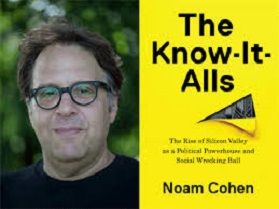
So author Noam Cohen is coming out with a book. He calls the book “The Know-It-Alls: The Rise of Silicon Valley as a Political Powerhouse and Social Wrecking Ball”. It is a scathing book about IT support culture in Silicon Valley. Have we sold our soul to Silicon Valley?
So the first problem Cohen has is with the tech monopolies. But I like to call them the Big 5. They are Amazon, Google, Apple, Facebook, and Microsoft. However, at first, they were all idealist companies. Today, they exploit their huge, huge, customer base for profit just because they can. Or at least, that the picture Cohen paints.
Then there is the progress their technology gives us. Maybe that’s why nobody wants to call out Silicon Valley on their sins. Nonetheless, Cohen has us asking, “Is it worth it?”. Is it worth them interfering with elections? Or is it worth them sending jobs overseas, or even replacing jobs with robots? Or how about the way they swallow up companies, creating monopolies, and leading to huge wealth inequality. Okay, this is mostly how I feel, but Cohen tackles these issues. Have we sold our soul to Silicon Valley? And if we have, can we do anything about it?
Not only does Cohen says ‘yes’, but he offers suggestions. He calls for anti-trust action to stop, or at the very least, curb these potential monopolies. Cohen worries that if only a handful of men control the way we buy, sell, eat, communicate, or do anything, that just spells trouble. And quite frankly, that worries me as well. This is what I mean by selling our soul. Because if we let a handful of men like Bezos, Zuckerburg, Cook,?Pichai, and Ballmer control our lives like this, then what now? And what if we decide to speak out? Will they retaliate by cutting us off and suspending our service? This may sound like a movie, but this is not entertainment. This is our reality. But I’m just a little computer repair blogger. What do I know?

Oct 14, 2017 | Uncategorized
Twitter can’t win. It’s been like this for at least a year. Because now, they face a boycott from women’s groups like #WomenBoycottTwitter. This started when they suspended actor Rose McGowan’s twitter account, as she addressed the Harvey Weinstein sex scandal. But Twitter promises even more rules.
Twitter says they suspended McGowan’s account because the Scream and Charmed actress tweeted a phone number, which is a privacy violation. But many aren’t buying it. Some even call it a double standard. They say this because women and minority groups have been victimized by Twitter trolls for a long time. However, they did little about it. But when McGowan posted her controversial tweet, they suspended her account immediately.
Twitter CEO Jack Dorsey promises radical changes. He says Twitter will outlaw the following: hate symbols, violent groups and glorification, sexual advances, forced nudity. Oh, they will be more new rules next week. The response to this IT service mogul is mixed. Some applauded his stance. But others replied by saying, “Then ban President Trump”. Still, even others say all parties are playing victim. This isn’t new to Twitter. Between 2015 and 2016, they trolled actress Leslie Jones and rapper Iggy Azelea so bad that Jones and Azelea down their Twitter accounts altogether.
But some trolls don’t stop there. Some even used Twitter to go after celebrities’ kids. You can’t get much lower than to go after somebody’s child! It seems Twitter can’t win. I’m sure there will be free speech advocates who say Twitter is going to far. And I’m sure there are some on the other side who won’t come back to Twitter, no matter what. Twitter use is down across the board. And this will certainly shrink usage further. With all computer servicing industries, with freedom comes responsibility. But look at our society today. We’re more divided than we’ve been, well, in my lifetime (I was born in the late 1970s). It seems like everybody is mad at everybody for everything. Is this really about Twitter rules…or is this a reflection of 2017 America?

Oct 13, 2017 | News, Smartphone
There’s good news and bad news about Samsung. So first, the good news: Samsung is having a Q3 2017 of the ages! Then the bad news: Oh-Hyun Kwon, the CEO and Vice-Chairman, resigned. It’s Samsung…best of times…worst of times.
Furthermore, as Kwon exited, he said his soon to be former company was in a huge crisis on all sides. He also called for new leadership. I find this funny because 2017 is a fairly good year for Samsung, at lest financially. They reported great first and second quarter profits, and have a strong third quarter to boast about. In fact, it could double that of Q3 2016. On the surface, they truly overcame the the Galaxy S7 debacle of 2016.
But let’s not pop the champagne yet. This smartphone company has legal and social problems. In 2017, Vice-Chairman Jay W. Lee was found guilty of bribery and perjury. They say he paid people off in order for political favors. They also say he gave $36 million in order to win merger support. In August, a South Korean court sentenced him to five years in prison. But Samsung officials elected him as a CEO in 2012. Now, he’s leaving. In a statement, he said he can no longer put off his resignation. Kwon also called for new, young leadership that can roll with IT support’s rapidly changing industry.
This really is Samsung…best of times…worst of times. It’s amazing how they are in the midst of a one of the greatest comebacks in IT service history. But they’re also in the midst of one of the biggest scandals in smartphone history. So how does this happen? First of all, I’m happy Samsung overcame their fiasco. The things they endured last year could have put any company under. It almost did. So if they can overcome that, then can’t they overcome this latest scandal?
Oct 12, 2017 | Smartphone
How many parents worry about their kids being on smartphones too much? I’m sure there are many, but one app is doing something about it. Here is to Kudos: Teaching kids to respect smartphones.
They made this app for children ages 8-13. So this app teaches kids of this age group to be responsible social media citizens. It also has around the clock moderation.? And they seem to be on their way. They moved to Silicon Valley, at a time many IT service companies are leaving. They also have help from Disney and Pixar, as well as over 5.7 million from capitalist investors.
A Norwegian man named?Vidar Hestaas invented Kudos. It started when Hestaas caught his 7 year-old son used his older sister’s Snapchat and Instagram. The son did this because he’s too young to use them; the minimum age is 13. So he invented Kudos not only to let younger kids use apps, but to teach them how to communicate with dignity and to be safe. In fact, the 7-year old encouraged him to make the app. Hestaas insists kids, and parents, keep a positive atmosphere. For example, they appoint ambassadors for those who model good social media behavior. They also have humans and software monitoring activity 24/7, reporting activity to parents.
Now I know what some of you are going to say. “Children that age are too young to use smartphones”. Maybe that was true in 2010. But today’s 13-year-old was born in 2004. They probably can’t even remember a time without smart devices. And you know today’s 8-year-old certainly doesn’t. So whether we like it or not, smartphone is here today. We’ve told people that in our computer service shop. So since it’s here, we need to teach pre-teens responsibility and accountability. We also need to teach them smartphones can be used for good, not evil. Then teach them to use it for good, instead of evil. I know many parents are concerned with bullying, especially in today’s social-political hostile climate. But how cool would it be if today’s 8-13 year olds were the first generation to stamp out online bullying and online hatred? Could Kudos lead the way?

Oct 11, 2017 | Computer technology, News
We saw many disaster unfold in recent weeks. So most recently, we have the Santa Rosa fires that killed 17 people, and destroyed whole neighborhoods. But how can drones play a part? Disaster drones: Can they save lives?
There is a drone company they call Cy Phy Works. Their locations are in Danvers, MA, about 25 miles north of our Boston computer service shop. So what do disaster drones do? First of all, they take pictures of the disaster area. This is important because they help relief efforts deliver accurate help to the right communities. Furthermore, these cameras are 30x zoom and can survey tens of miles per trip. For example, they took pictures of areas Hurricane Harvey flooded and were able to get the help to desperate area.
Also, for the recent fires, they can use disaster drones to show firefighters which communities need the most aid. But that’s not all. These drones can also deliver medical supplies and other aid. Some supplies could even include instructions for people to help themselves before help arrives. And of course, the drones can get directly to an emergency site. In most cases, they can get there just as fast, perhaps even faster, than first responders can. Obviously, they will work with emergency personnel. This is about saving lives, not a ‘who can get there first’ competition.
Cy Phy Works recently ran tests throughout the Boston area. During our busy times, like the Fourth of July, they provided surveillance with the Boston Police Department. By all accounts, these tests were a success. These drones couldn’t have come at a better time. For the last six weeks or so, we have been bombarded by disasters. And yes, I talk about the bad technology and IT service can do. But once in a while, we should be reminded of what good our industry can do. In this case, it can literally mean the difference between life and death. As a New Englander, it gives me great pride to know my state came up with this drone. Do you think this disaster drone can save lives?
