Sep 18, 2015 | Entertainment, internet
Last year, Microsoft teamed up with the NFL. The NFL used their tablets for coaching and game calling purposes. This year, a social media company teams up with America’s most successful sports conglomerate.
Snapchat and the NFL have a one year deal in which Snapchat that will provide NFL video and photo footage to the NFL’s Live Story feature. This feature will go from the beginning of this season through Super Bowl 50, which is scheduled for February 7, 2016. Snapchat will host a NFL Live Story episode every week/end. Both will peddle to advertisers and both will split profits. But there is a catch. Snapchat is forbidden by the NFL to use NFL broadcast footage. This means most of Snapchat’s footage will be coming from fans like you and me. The NFL season and Super Bowl aren’t the only upcoming happenings for Snapchat. Recently, Snapchat has covered live events from fashion week to the Republican presidential debates. And Snapchat isn’t the only social media venue the NFL is making deals with. It has partnerships with Facebook and You Tube. Remember last Super Bowl, when certain commercials aired on You Tube first? The NFL announced a two year partnership with Twitter. This is a trend that is going nowhere fast.
Despite scandals and disputes that seem to follow the NFL everywhere, from Ray Rice to Deflategate, the NFL is still the number one sports franchise in the USA. Many millions follow their favorite team on any given Sunday…and Monday night…and Thursday night. Over a hundred million Americans watch the Super Bowl every year. Snapchat knows it and the numbers prove it. Live Story already draws an audience of 20 million people. Facebook, You Tube and Twitter know the economic power the NFL has. The NFL knows social media is the new way of communication. Sounds like both are doing the smart thing and playing off each other. Is this a good relationship?

Sep 17, 2015 | internet
Did anyone see last night’s Republican presidential debate? It’s all people are talking about on Facebook this morning. As you know, there is a lot of tension and dissension between the two parties and within the parties. Many FB friends give their take. This sounds like a perfect time for Facebook’s dislike button.
Two days ago, Facebook CEO Mark Zuckerberg announced his company was working on a thumbs down ‘dislike button. This comes at the request of countless FB users. Zuckerberg said people have been pressuring him about a dislike button. The dislike is supposed to be used for posts deemed sad or negative events happening to the person. The dislike button isn’t supposed to be used toward the content of a post. For example, someone talks about a job loss, death in the family, disease diagnosis, divorce/break-up, or a bad news event that happened in their community. The dislike button is to express empathy toward the person enduring such events, as in saying, “I dislike this trauma or hard time you’re going through.” Zuckerberg said, “We really want the ability to express empathy. Not every moment is a good moment.” He talked about he and his wife’s fertility struggle as an example. To the best of my knowledge, there is no debut date set for the Facebook dislike button.
So it’s supposed to be used for empathy. But come on, guys. You know it’s going to be used, even abused, to judge someone else’s content. I and anyone with a little street smarts see it coming. Don’t get me wrong; I’m for the Facebook dislike button. That’s because I’m for anybody and everybody using their free speech, as long as it’s done in a non-threatening manner. ?But why do you think so many people are on Zuckerberg’s case to build a dislike button? Why do you think so many people want this button to begin with? What’s empathy got to do with it?
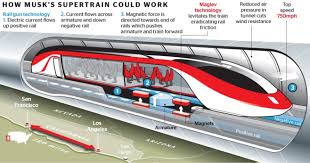
Sep 16, 2015 | Computer technology
Traffic in the United States is worse than it’s ever been before. Our road infrastructure is in desperate need of repair. So is our public transportation systems. Twenty-first technology is here to help.
A group called Hyperloop Technologies is working on supersonic traveling. They want to move people and cargo so fast it rivals the spirit of sound. And it will be ground transportation. Hyperloop would travel through tubes at nearly at supersonic speed. With Hyperloop, one could travel from LA to San Francisco Technologies at 385 mph. It would get you there in 30 minutes! It takes an hour to fly from LA to San Francisco, and that’s just the flight alone. Inside this tube, there’s a pod for people and/or cargo. Hyperloop travel has been years in the making. Tesla CEO Elon Musk revealed the design back in 2013. Musk argues this is the only way to have fast travel. They already have $90 million in funding. Hyperloop leaders are optimistic about the system being constructed within 3 years. They believe they’ll be moving cargo and passengers by 2021. If Hyperloop is successful, it could be one of the biggest breakthroughs in travel technology history. You could put it up there with the Wright Brothers at Kitty Hawk, Henry Ford building Model-T’s, or the Concorde flying from New York to London in four hours.
Personally, I hope this is successful. Americans waste 42 hours a year in traffic, and cost Americans $160 billion a year in vehicle destruction, wasted gas, and lost production. Yet California is the only state investing in bullet train transportation service. Some may call Hyperloop science fiction. I call it a great idea. I was in Boston during the blizzards of January/February 2015. Public transportation was crippled to a standstill for many weeks. In fact, it was St Patrick’s Day (March 17)?before things got back to normal. And Boston has one of the best public transportation systems in the nation! Now do you see why Hyperloop needs to be successful? Do you see why the United States needs supersonic travelling?
Sep 15, 2015 | News
The refugee crisis in Europe has dominated the headlines. Thanks to years of civil war in Syria, countless refugees are flooding into Europe. Germany has agreed to take in up to 800,000 Syrian refugees. What does this have to do with anything technology?
Facebook leaders are helping out…somewhat. They’re working with the German government to silence hate speech and xenophobic comments. Facebook leaders, the German justice ministry, ISP’s, other organizations, governments and businesses form a task force to delete hateful comments toward these incoming refugees. Facebook is expected to team up with German financial institutions to track hate speech. Germany promised to take in more refugees from war torn Syria, and some from war torn Afghanistan, than any nation on Earth. But last month, Germany’s Justice Ministry Secretary Heiko Mass criticized Facebook for not doing enough to combat hate speech. Some are even bracing for xenophobic riots. In Hungary for example, the border has been closed to migrants. There’s been tension in other parts of Europe as well. According to German law, comments, whether spoken by word or through computer, that incite violence, especially against another race or ethnicity, can land someone up to three years in prison. No Facebook leader or representative have commented on this initiative.
I somewhat get where Heiko Mass is coming from. These incoming refugees should be treated with dignity and respect. They’ve already been through war and violence. They don’t need to endure bullying and trolling. But these efforts sound more like Orwellian/Big Brother than protecting refugees. ?What will they consider offensive? What if someone makes a great case on Facebook against bringing in so many refugees? Is that offensive? Will that person be thrown into prison? It should never be any government or online company’s place to determine what is offensive or hateful and what isn’t. We live in a time where phrases as innocent as, “nice dress”, or “you look nice today” can be called offensive. What Mass and other leaders should do is urge and encourage tolerance of these refugees. Run commercials urging and educating people to do the right thing. But the way Facebook and the German government are handling this, they’re crossing a line that shouldn’t be crossed. Do you think this initiative is protection or censorship?
Sep 14, 2015 | Smartphone
Remember when I asked how the iPhone would do this time, especially with smartphone competition at an all-time high? I guess that was a silly question. This year’s batch of iPhone products breaks records…again!
Apple just announced they’re on pace to beat last year’s iPhone record. Apple’s stockholders are liking that news. This same statement said iPhone pre-order sales are very strong around the world. One blog says the wait time for the big iPhone 6 Plus is between 3-4 weeks. The iPhone 6S is expected to take between 2-3 weeks. Apple reports and blogs insists they’re doing the best they can to process pre-orders as fast as they can. They remind customers they can get the new Apple iPhone 6 Plus and 6S at their nearest physical Apple stores starting Friday, September 25. Sales in the US are doing well. But insiders are really impressed with pre-orders in China, despite the economic slowdown in that nation. The order wait time is particularly long there, and China seems to be leading the world in new iPhone 6 demand. Even during the Chinese stock market mayhem, Apple CEO Tim Cook told CNBC through email they’ve had strong economic growth in China.
There’s a lot that can be said about this. Apple definitely has a major, loyal fan base. I think we all knew that. But I’m totally shocked at China’s response at these new products. Have you seen the summer China had economically? Do you remember how much they lost in the stock market this summer? But yet China is virtually leading the world in new Apple iPhone sales. I’ve also read China has the biggest wealth inequality gap of any nation on Earth. If that’s truth, then who do you think is buying up these phones? The new iPhone 6’s don’t come cheap. So what does this scenario really tell you about China’s economy? Or am I reading too much into this?
Sep 13, 2015 | internet
Google Fiber is Google’s way to provide faster Internet and better cable TV services to various metro areas around the United States. They’re looking for new cities and states to expand in. Two areas are high on their list.
Those two areas are Irvine, CA, San Diego, CA and Louisville, KY. It has to get approval from local government leaders. But if Google’s plans go through, it will be the first time Google Fiber has ever been in Southern California or Kentucky. Fiber promises services up to 100x faster than rival Internet services. Google Fiber Internet costs about $70 a month. For five years, Google Fiber has been instrumental in pressuring major broadband companies like Comcast and Verizon to move to faster speeds. Google Fiber is already available in both Kansas City areas (Kansas and Missouri), Provo, Utah and Austin, Texas. It’s scheduled to come to various cities and towns in North Carolina, Georgia and Tennessee. It’s also scheduled to come to Salt Lake City, UT and San Antonio, TX. As many as twelve months may pass before Google Fiber comes to Southern California and Louisville, KY. That is, assuming Google and local officials can agree and collaborate to bring this ultra-fast Internet service.
Now a question comes to mind here. Why is it taking so long for Fiber to come to greater Los Angeles/San Diego? This is one of the biggest metropolis areas in the nation. One would think this and the New York City Tri-State area would be the first to get Fiber. Blame corporate competition for that. Cox Communications is working on Southern California by offering gigabyte service. I often wonder if politics have something to do with it too. But Google Fiber is growing in states that are rapidly growing in population. Should Google Fiber do even more to target major metropolis areas?
Sep 12, 2015 | email, Entertainment, Humor, internet
Everyone loves the emoji. What better way to express yourself than the cute little faces and symbols one can put in emails and social media posts? But there is new emoji coming out that isn’t so cute.
The undesirable emoji I refer to is the middle finger emoji. It’s officially called Unicode 7. It took 15 months for it to be approved. It will be available on iOS 9.1. At the Apple conference last Wednesday, a lot of new emoji symbols were introduced, such as the hot dog, taco, burrito, champagne bottle, unicorn, even a Jewish synagogue. But the one that stands out to me is this very direct middle finger that needs no translation. To be fair, the signal has always been in the computer world somehow. Emoji One, What’s App, and Windows 10 has the finger cartoon. But Apple’s 9.1 version has the best version (if you want to call it that) of it. Let’s say you wanted to upset someone. You had these four finger versions to choose from. You’d want to choose the iOS 9.1 version. Don’t go rushing to your iPhone device to get this emoji yet. It won’t be available until next year. I’m sure there are those, including some of you reading this, that can’t hold out that long.
From an economic standpoint, this emoji is going to be a huge seller. I just feel it. I am totally for free speech and First Amendment rights! I hate censorship. So I don’t think this emoji should be taken down by any means. But I?have to throw my moral card down. Isn’t there enough hatred and anger in the world today? Does Apple really want to add anymore? If you’re dissatisfied with something, or someone, isn’t there another, more dignified emoji you can send? Yes, the middle finger emoji is legal and constitutional. But is it responsible and is it right?
Sep 11, 2015 | Smartphone
It’s been two days after Apple made yet another historic press conference. Android/Google is ready to strike back and strike back immediately.
This is where Android Pay comes in. Android Pay debuts to the public today. This service is available?to all Android phone customers. Now, they can use Android Pay at one million retail stores across the US. To take part in Android Pay, your Android smartphone has to run 4.4 KitKat or newer. It needs an NFC chip. You can find the Android Pay app in the Google Pay store, and you need a credit/debit card to back your Android Pay account. It works with the most popular banks and credit card agencies. You can use your fingertip or passcode for security. Instead of storing credit card information, it uses ‘tokenization’. In an event your Android phone is lost or stolen, numbers on your phone can’t be exploited. Google Wallet is going nowhere. In fact, Wallet and Android Pay use the same technology. And like Apple Pay, most major retailers are accepting and embracing Android Pay. These retailers include Walgreens, Macy’s, Whole Foods, and Rite Aid. Eventually, Pay will have in-app payments as well.
Like I hinted before, you gotta applaud the timing of Android Pay’s debut. Sure they’ll probably say Apple had nothing to do with the chosen release date, but it’s just too much of a coincidence to me. Fingertip technology is a huge plus. First off, passwords are difficult to remember for many. Second off, hackers are getting smarter and smarter at breaking in smartphones. But what about smaller banks and small businesses? Do they have the capabilities to accept Android Pay? Do they have the will to? Who will win between Android Pay and Apple Pay? Or will there be any winners?
We at Geek Choice would like to take time to honor and remember the victims, families, and survivors of the devastating 9/11 attacks on our nation. Let’s love and respect each other.
Sep 10, 2015 | Computer technology, Entertainment, internet, News, Smartphone
Yesterday, Apple held their annual September press conference. They demonstrated new and improved items for the upcoming 2015-16 year. As usual, Apple had the media and the public talking.
Yes, new iPhones were revealed, but that was the mid-card side show. The main events were the were the super sized 12.9 inch iPad Pro and Siri controlled Apple TV (which I talked about several times). Apple iWatch bands also made an appearance. We knew this was going to be an awe-inspiring show when Cook said monster announcements are in store. There were 2 1/2 hours of them. There were a few pleasant surprises. The new versions of iPhone 6 will cost the same as the old ones. But this iPad Pro is as powerful as is large. Thanks to A9X, it has twice as much memory bandwidth and ?store performance as it’s predecessor, iPad Air 2. Maybe that’s why it has twice as much price. The smallest iPad Pro will cost $749. The LTE 128 GB model will cost $1,079. Then there’s the Apple TV. The remote might be the best thing about Apple TV. It’s small, sleek and contains Bluetooth support and a touchpad to live for. The Siri app is even more far out. I saw a demonstration where the man said comedy. Apple TV immediately downloaded all the comedies available to him. There are so many apps here I don’t know where to begin. Don’t expect Apple TV to come cheap. They closed with multi platinum selling pop group One Republic.
Obviously, I can’t cover everything about this conference. So you can click here to watch the whole conference. And it was a great one. But here comes the big challenge: turning this conference into sales in the months to come. Will people buy this Apple TV over competitors like Amazon? Are people willing to pay anywhere from $750-1,080 for iPad Pro? Will Siri make you sorry you ever invested in your new Apple TV? Apple has talked the talk. They set the expectation bar high. Can they walk the walk?
Sep 9, 2015 | Uncategorized
I’ve been blogging on this wonderful Geek Choice site for over two years now. I’ve learned lots. I’ve learned Japan is robot obsessed! They’ve got everything from robot girlfriends to all-robot operated hotels. Guess what they came up with now?
Here I am introducing robot boss. Last week, Japanese multinational conglomerate Hitachi announced an artificial intelligence boss called AI to dispatch employee duties, responsibilities and work times. In fact, they put AI in charge of warehouse management. Somehow, AI managed to get an 8 percent work production increase among it’s human employees. In that same statement, Hitachi praised AI for this increase, and wants to further AI and human cooperation. Yes, ?machines and humans have been working together since the 18th century, when the Industrial Revolution began. But this is a level virtually unheard of 20 years ago. Hitachi’s AI robot has the authority to send out tasks, quickly adjust work orders, even adjust work orders depending on inclement weather. This fusion of human and artificial intelligence is part of a Japanese business concept called kaizen. That basically means employers, managers and workers are always urged to improve work production, and implement new ways to do so.
I’m not a fan of humanizing robots, unless they’re in movies or on TV. But this robot boss could go either way. You can’t get away with blame it on the weather…because apparently, AI will find you out. But if I were at Hitachi, I would miss the human approach of having a boss/manager. Who is going to invite me to barbecues and other company outings? Who is going to praise or raise me when I do a good job? Who is going to teach and correct me when I’m doing wrong? Who will I go to for advice? But then again, do you think a robot is going to fire me for pulling an office prank or throwing an unexpected office party behind his back?
