
Aug 18, 2016 | Computer technology, Smartphone, Software
Just think: Five years ago, nobody ever heard of Uber. The only ride sharing services were taxis. Years later, Uber comes out. Uber starts a social media and app revolution. They’re not done yet. Uber’s self-driving car is almost here.
These cars are specialty made Volvo XC90s. Human drivers will just occupy the driver’s seat and supervise. The experiment will start in Pittsburgh. Later this month, Uber allows customers to choose these self-driving Volvos for service. There’s a reason this experiment is happening in Pittsburgh. It’s home to Carnegie Mellon University’s robotics program. This program helps Google produce self-driving cars. Now they’re helping Uber. That’s not all. In July 2016, Uber acquired Otto. I’m not talking about the Simpsons bus driver. I’m talking about Otto the start up driver less trucking company. Otto has 91 employees, all trying to bring self-driving technology to tech corporations. Otto currently develops big rigs to drive themselves so well drivers can catch up on sleep…while literally on the road! Uber will not produce fleets of self-driving cars. Instead, they’ll work with Volvo to produce self-driving models. Otto will help with lasers and other systems used in self-driving cars. Hailing a self-driving car will be as normal as any other car, even down to the price.
I must tell you, don’t go requesting a self-driving car in your home town. This is just an experiment. This experiment will only be done in Pittsburgh, PA…for now. But if Uber is going to get into the self-driving game, they should do a better job setting themselves apart. They’re starting to do this. They have Otto on their team; the other companies don’t. They’re not producing a fleet. Apple, Google and Tesla are. What I think they should do is invest in self-driving big rig trucks, maybe even put their name on them. I know the 18-wheeler isn’t Uber’s business…yet. But neither is car manufacturing Apple’s business…yet. If I were Uber, I’d work miracles with Otto and cause yet another social media and highway revolution…this time with mack trucks. How will Uber do with self-driving cars?
Aug 17, 2016 | Computer technology, Software
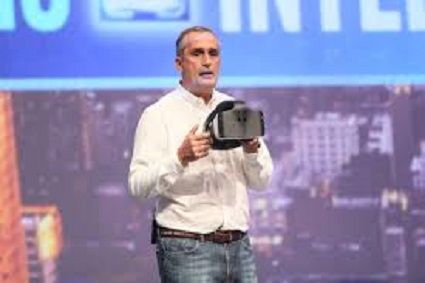
Intel’s revolutionary Project Alloy takes the VR (virtual reality) movement to another level. An Intel Developers Forum wants your VR experience to be without restraint or restriction.
Project Alloy is a virtual reality system that is completely wireless. Not even leading VR devices, like Oculus Rift, can boasts this. Intl’s VR headset has all cameras, sensors and controls all rolled up into one. Intel CEO Brian?Krzanich’s motive is clear. He and his top colleagues want a free moving VR experience. This means no wires, no screen issues, no technological hangups whatsoever. Project Alloy relies on hand tracking technology and integrated sensors. They use Real Sense technology and lasers ?to capture people walking into a virtual world. Other successful virtual reality devices have great frame rates and clean screenings. These headsets depend on their wiring to ensure quality frames and screens. Intel is partnering with Windows. Windows Holographic and Project Alloy will combine forces and operating systems to build powerful applications. This system is very early in development, although Krzanich gave a public demo about it. I say this because Project Alloy probably won’t be made public anytime soon. It mid to late 2017, it will reveal the Project Alloy hardware. This is so Alloys Hardware and Windows Holographic can be easier to combine.
Let’s get back to wireless. Just how is Intel going to give us the quality we need by cutting wires? If I were a VR fan, I’d hope Intel would give us the quality and wireless technology to make this work. If they do, that alone would set them apart from the competition. That would be good for Intel business wise. That would be good for virtual reality customers and enthusiasts. But what about socially? I wouldn’t want people to live in their fantasy VR world 24/7. I know it sounds far fetched. But I think so many people are disillusioned by the real world that they’d be happy with 24/7 VR. What these wires do is limit VR headsets. In some ways, they keep us from going too far. I’m afraid of what we’d do with wireless VR. Would wireless VR mean social chaos?

Aug 10, 2016 | Computer technology
Many people anticipate the upcoming iPhone 7. You don’t think Apple would leave it there, do you? Insiders say Apple is revamping it’s most prized wearable technology: the iWatch.
Tech reports out of Asia say Apple is working on a whole new Apple Watch. This device will focus on health. This watch would inform the consumers’ blood pressure, heart rate, blood sugar level, and pulse reading. The wearable device is the brainchild of Jay Blahnik. Blahnik is Apple’s Director of Fitness and Health. He and his health technology team hope this will cause a wearable technology revolution. This has been in the making for well over a year now. However, don’t expect it anytime soon. This super device won’t be out until 2017. Apple has recruited Foxxconn, Zhen Ding Technology, and other tech companies to produce the new device’s parts. Apple wants to break into health care so bad. They have an entire health care team, led by Jay Blahnik. They have health care products such as Health Kit, Research Kit and Care Kit. These items already do some form of health monitoring. So if this new wearable health device is going to sell, I hope Blahnik’s team step their game up.
One thing this new device won’t be: Apple iWatch 2. First of all, that’s coming out in September 2016. This is to complement the iPhone 7 release. Second of all, they don’t want this device to be another iWatch. They want this to be a revolutionary health device. I can’t report too much on what’s going to be on it. That’s because Apple is being hush-hush about it. That’s Apple. What else would you expect? You wouldn’t want Google/Android to get your secrets, would you? What would you like to see on Apple’s new wearable device? When would you like to see it released? What should the name of it be?

Aug 8, 2016 | Computer technology
Flying isn’t what it used to be. You’re charged for checked baggage. You’re prodded through security. You may not be able to fly at all. Delta passengers aren’t. That’s because a failed computer system grounds Delta Airlines.
The problem started around 2:30 am this morning. A power outage hits Atlanta, Delta’s global hub. Now, Delta’s computer systems worldwide are stalled. The company warned customers can expect many cancellations and delays globally. Delta assures their technicians are doing all they can to rectify the issue. Delta offers a waiver for anyone traveling between August 8-12. That means if you’re scheduled to fly Delta between these dates, and want to change your dates, you won’t be charged change fees. But the damage is already done. The airport lines are piling up. The passengers are stranded. The tempers are flaring. I heard one passenger already stranded because of weather. Now he has to deal with the computer glitch. Tens of thousands are affected. Not only that, some systems are giving false information. They may tell passengers they’re flight is boarding, only to learn it’s been cancelled. How cruel is that? Delta stocks take a hit. The glitches, delays and cancellations have little end in sight.
Unfortunately, airline computer glitches, and the mayhem they bring, aren’t uncommon. On July 8, 2015, United Airlines grounded all flights due to a computer glitch. Last month, Southwest Airlines faced massive delays and over 2,300 cancellations due to computer glitches. Experts report Delta’s glitch will be even worse. This tells me something. The problem isn’t necessarily with the airlines. Something is wrong with our tech infrastructure. It’s 2016. Airline passengers shouldn’t have to be subjected to computer glitches every month. We have bright minds all over America to tackle this issue. I think all airlines should have a joint summit to discuss this habitual problem. Then they need to come up with a solution to fix the problem, for good. I’d like to see Congress grill airline CEOs into making their technology infrastructure better. And why are we using 1970s technology? That’s what I want to know. What can be done to prevent the next airline computer glitch.
Aug 3, 2016 | Computer technology
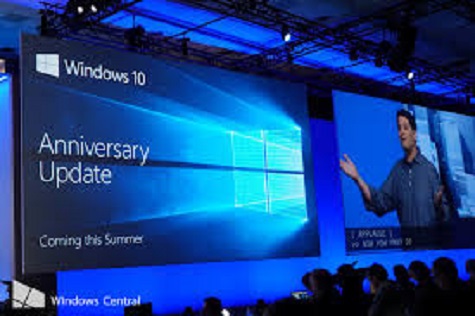
Somebody celebrated a birthday yesterday. Well, a lot of people celebrated birthdays yesterday (happy 39th Tom Brady!). But it Windows Ten’s first birthday. How does Microsoft celebrate?
They celebrate by giving us a new version of Windows 10. Don’t forget: There will be no Windows 11. They stop at Windows 10. Everything else will be updates. This update will be called Windows Ten Anniversary Update. The update is free. But if you have Windows 10, you’re going to get the update, whether you like it or not. One update feature is Cortana. With your voice, you ask Windows 10 simple questions. Windows 10 will answer you. Your computer and smartphone will be able to talk to each other. The edge browser gets better. It accepts extensions from Chrome, Firefox and other web browsers. It also includes password memory assistance and ad blockers. And it uses low battery power. If you still struggle with passwords, you can use facial recognition. Just look at the picture and you’re in. Some machines us fingerprint technology. This is called Windows Hello. Windows insists your face and fingerprint will be confined only to your machine. Do you have a Microsoft Pen and Surface Tablet? Good! You can use sticky notes and a sketch pad. If you forget anything, just depend on Windows Ten Anniversary Update.
Personally, I think Windows 10 is the best thing that came out of Microsoft in years. Windows 10 Anniversary Update has some good qualities. First of all, it’s free. But some Windows 10 customers may not want this update. I don’t agree with forcing this down customers’ throats. I like edge browser’s password assistance. But I am not on board with facial recognition technology. It seems secure. But what can Microsoft do with your facial recognition? What can other government and corporate entities do with facial recognition? How much can you be tracked? That’s the scary part about fingerprint and facial technology. But the rest of this looks good, especially password memory. That’s the best selling point. I struggle with password remembrance quite a bit. I, and many others, could benefit. What’s your favorite Windows Ten Anniversary Update?

Jul 18, 2016 | Computer Repair, Computer technology, Security
There’s no doubt about it. One of the biggest threats to computer technology is the computer virus. It can lead to ID theft, malware, even crimes like sextortion. There seems to be no end in sight. But one government agency vows to fight this epidemic.
DARPA (Defense Advanced Research Projects Agency) brings top tech security experts to fight viruses. The event is called Cyber Grand Challenges (CGC). This event will test auto programs that look for computer vulnerabilities. Then, can they create and fix the vulnerability before the virus strikes? Can they do so without human help? A lot is riding on this. If this CGC is successful, this could mean no more cyber attacks on our devices. Yes, I know there are people and companies that fix viruses. We at Geek Choice do so all the time. Yes, there are security software firms like Avast who prevent viruses and malware. But according to DARPA program manager Mike Walker, it can take over 300 days to find a security flaw. Hackers can do much damage in that time span. Operating systems run on millions of code lines. All it takes is one mistake in one code line to attack a computer or device. Even with these anti-virus programs and computer repair services, as great as they are, can’t totally protect you from flaws they don’t even know about.
I’m glad DARPA is on the case. We can’t go through a week without reading about a major hack attack. And it’s not just people in labs and basements either. Governments are hacking each other. I’ve read reports of Russian and/or Chinese hackers attacking our political ?conventions. We’re all in the war against computer viruses. All of us. So I’m not jealous at all of this CGC program. In fact, I hope it goes well. Wouldn’t it be great to live in a world without viruses, malware or the crime they bring?
