
May 17, 2016 | General, Testimonial
May is the month when many celebrities and public figures speak at college graduations throughout the US. This year, one tech leader’s speech should teach us all a thing or two.
Facebook COO Sheryl Sandberg gave the commencement address to the University of California-Berkeley’s class of 2016. Sandberg got their attention immediately when she started with this statement: “I’m not gonna tell you what I learned in life. Today, I’m gonna try to tell you what I learned in death.” Here, she referred to the sudden death of her husband, David Goldberg, back in May 2015. She used her time of mourning to encourage the new graduates to persevere in the face of hardship, challenges, and especially tragedy. She shared the hard lessons she learned on overcoming difficult times. Sandberg reflected on the gratitude she found for family and friends. She reflected on the little things, like the laughter of her children. She urged the graduates to be grateful on any day and in any situation, good days and bad. She told them to never take life for granted, or take their loved ones for granted. Sandberg recalls asking herself the question, “What would she do if she had 11 days left to live?” She reminded the crowd that every day is precious and urged them to be there for their loved ones, not just through technology.
From what I’ve read, Sheryl Sandberg’s commencement address is one of the best graduation speeches ever. So many others give you advice about jobs, careers, and such things. Sandberg’s gives you advice about two things we will all face: living and dying. As techies, it’s easy for us to post a message or texts to our loved ones and think we’re doing something. I’d like to challenge us to write a hand written letter, make a phone call, or even pay a visit. In this fast pace world of technology, let’s slow down and appreciate the little things. When I look at the world situation, I don’t see it getting any better. Sandberg is right; we need to appreciate every day we get. What did you think of this commencement speech?
May 16, 2016 | Computer technology, Smartphone
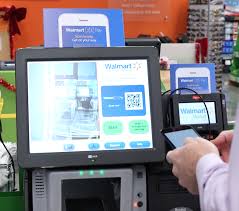
Today, America’s biggest retailer releases Walmart Pay. It’s Walmart’s own mobile pay service, kind of like Apple Pay. Walmart Pay is being tested in 600 stores throughout Texas and in it’s home state of Arkansas.
It should be made clear: Walmart Pay is not a part of Apple Pay, Samsung Pay, or any other mobile pay entity. Walmart Pay is it’s own entity and it’s competing with other mobile pay companies. In the next few weeks, Walmart Pay will spread in the Midwest and Plain States. Walmart Pay is available on Apple and Android devices and works with all major bank cards and Walmart gift cards. When you buy at any Walmart in this part of the country, open the Walmart app and hit Walmart Pay. Scan the QR code on the register screen, using the phone camera to connect to Walmart Pay. The app will give you an electronic receipt. Walmart Senior VP Daniel Eckert embraces Walmart Pay not only as another payment system, but as a way of improving the checkout experience altogether. This is just Walmart’s latest attempt to get in the good graces of the technology community. They’ve got a subdivision in the Silicon Valley. They’re also working on drones to deliver their groceries to customers.
But one thing about this boggles my mind. Walmart leaders insists this isn’t to compete with Apple, Samsung, or Google Pay. But yet none of them are accepted at any Walmart. This includes those 45 or so states that won’t see Walmart Pay anytime soon. I smell at best, a strategy and at worst, a lie. If they’re not trying to compete, then why are they setting up shop in Silicon Valley, the tech capital of America? Why are they trying to do like Amazon and set up drone services? Does Walmart think we’re stupid? Of course they’re competing. But how will this retailer do against the big boys of technology? Are they in the same league? Or have they bitten off more than they can chew?
May 15, 2016 | Uncategorized
Not so long ago, I wrote about a controversy surrounding Facebook. A former Facebook employee revealed that in their Trending List, they often suppressed and censored right-wing conservative based articles. This controversy isn’t going away anytime soon.
Even Senators like John Thune (R-S.D.) are asking questions. A correspondent on Yahoo News put up an interesting display of Facebook Trending. These are supposed to be the top trending news articles of that particular day. Some topics have valiant and credible news, like Wal-Mart suing Visa over RFID chipped credit cards. It has credible pop culture stories, like Budweiser changing beer label to ‘America’ until the November presidential elections. But the majority of the articles are pure fluff. For instance, one story that made the top trending list is Steve Lombardi, a WWE wrestled who performed under the name Brooklyn Brawler since the 1980s, was released. Even most WWE fans probably don’t know who the Brooklyn Brawler is. This concerns me because 61% of Millennials, born between 1981-1999, get their news from Facebook. That’s according to a 2015 Pew Charitable study. What’s even more disturbing is according to PolitiFact, the majority of stories are on some level made up. Not so long ago, Breitbart got in trouble for posting not-so-true stories. But now that they’ve become Trump supporters, they rarely make it in the trending section.
I am not here to endorse any presidential candidate. But I think Facebook should be a little more discerning about what goes in the trending box. But we can’t blame all of this on Facebook. We as consumers have to share some of the blame. When we care more about the Kardashians than we do about the Middle East, what do you think is going to trend? When we care more about Kelly Ripa and Michael Strayhan’s TV split more than we do about injustice in our community, what do you think will trend? When we care more about Beyonce’s Lemonade sales than we do about corruption in high places, what will trend? So what’s worse than trending? Is it the people who are driving the popularity of these stories?

May 14, 2016 | Security
Over the last several years, there has been a lot of concerns online: hacking, ID theft, sextortion, government surveillance. These privacy and security issues deter online users, and it affects consumers and businesses alike.
Almost half of online consumers have been deterred from the Internet in some way, according to a study by the Department of Commerce. In fact, 30% of the 41,000 household studied say such concerns deter them from at least two Internet activities. These activities are: Banking/financial transactions, buying online, posting on social media, addressing controversial issues. Nearly half of those polled were afraid to bank online. One in every four were afraid to shop online or post on social media. One fifth of those surveyed were afraid of expressing controversial opinions. When asked what was their biggest fear, 63% of them said ID theft. Other fears include bank fraud (45%), corporate data collection (23%), personal data hijacking (22%), government data collection (18%), and personal safety issues (13%). The study suggest the more devices an individual or a household had, the more likely they would be to suffer at least one of these woes. This concerns security analysts because in order for online businesses to survive, much less thrive, there has to be some sort of trust between vendor and consumer. And it doesn’t look like there’s too much trust going on.
But on the bright side, this means the majority of consumers, though it’s a slight majority, don’t let such threats deter their online habits. But we need to do better. There are things you can do to protect yourself, like setting up challenging passwords and be careful of who you let in your social media circles. But there’s also more our government and corporations can do to protect their people. As we hear more stories of fraud, my fear is that these numbers will increase as the years drag on. If that happens, then the only people who will win are the bad guys. Ethical online businesses will go out and consumers will be consumed by fear and cynicism. Do you see why we have got to do better?

May 13, 2016 | networking, Smartphone
The last several months have not been kind to ride sharing app Uber. In Kalamazoo, Michigan, an Uber driver went on a shooting spree, killing several people. In Austin, TX, a economic/political dispute lead to them leaving that city. For the third year in a row, Uber is one of the most hated companies in America. Now, Apple gives them a global blow.
Apple Inc announced it will invest a billion dollars in Chin’s ride sharing service?Didi Chuxing, Uber’s rival in China. Tim Cook makes this move for several reasons: to better understand the Chinese market, to put Apple in the ride sharing conversation, and to boost the company name and profits in China. Didi Chuxing leaders say this was the biggest and most important investment it ever received. Didi Chuxing already dominates China’s ride sharing industry, making up for 87% of the sales. The company arranges 11 million rides a day and is worth over $20 billion. You see, China’s economy has slowed all 2016 long, and Apple wants to help turn the tide. Apple has enjoyed a rather warm relationship with China. Look at how many Chinese workers are building our Apple products. China has the second biggest economy in the world. If you ran a multi-billion dollar mega corporation, wouldn’t you be friendly with China?
There are rumors in the Silicon Valley that Apple wants a piece of the ride sharing industry. That shouldn’t sit well with Uber at all. Apple already has an alliance with the biggest ride sharing company in China. Uber wants to expand in China. The competition there, already stiff, just got even tighter. Now Apple, one of the most popular companies in America, might compete in ride sharing against one of the most hated. Can Apple pull off a ride sharing firm? Will they take what they learn in China and apply it in the US? Should Uber be nervous?
