May 27, 2016 | Computer technology, Software
Have you ever owned a 360-degree camera before? Have you ever made your own? ?If you have, then you know the high maintenance software and equipment it requires. There might be an easier way.
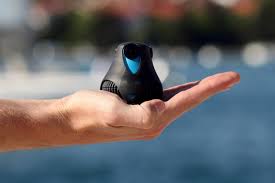
The good people at Giroptic introduce their 360cam. It includes everything you need to take 36o-degree photos and videos, and you don’t have to add anymore software. It can fit into the palm of your hand. It has three lenses, one on each side, but none underneath. A 360-degree camera may seem complicated and intimidating, but this one doesn’t seem to be. It has one power button. The other button controls the camera’s modes, like video, photo, burst and time-lapse. It shows you the camera’s battery life and camera mode. It has lock in technology for your security and protection. It coincides with the Giroptic 360cam app, which can be downloaded on Apple and Android smartphones. There, you can easily share your photos on Facebook, You Tube and other social media sites. It’s definitely waterproof. I saw a cool demonstration of a man taking videos literally in a wishing well. Not only didn’t it short circuit, it got great views of the city while it was underwater! The Giroptic 360cam will cost you at least $500.
So is the Giroptic camera a good buy? It depends on the individual. If you’re going to spend $500, or more, on this, then you’d better use it regularly and take care of it…regularly. Fortunately, this camera is easier to take care of than if you built one yourself, then had to pay for the sophisticated software. Plus, a 360-degree camera can take pictures and videos like nobody else. If you can get a photo of an entire city spinning around without, and do so underwater, then do so! Just be ready to invest time, money and energy. Is Giroptic 360 camera the right investment for you?

May 26, 2016 | General
The middle class is shrinking in the USA. This isn’t a conspiracy theory. Statistics prove this as a sad fact. Silicon Valley, America’s tech hub, is no exception.
The Silicon Valley consists of San Francisco, Santa Clara and San Mateo ?counties. It’s home to Facebook, Google, Apple, Yahoo, and dozens of other tech corporations. During the Great Recession of the late 2000s, Silicon Valley was one of the few regions of America that remained profitable. Unfortunately, it came at an unfair costs. Today, these three counties have one of the biggest economic gaps in the country. In 1989, Silicon Valley’s top 1% owned 13.3% of county income. By 2013, Silicon Valley’s top 1% owned 28.3% of all county income. In 1989, the number of middle class households in Silicon Valley were 56%. By 2013, the number of middle class households in Silicon Valley was 45%. In San Francisco, the top 1% earns 43 times that of the 99%. Low income households are doing worse. While Silicon Valley’s one percent boomed in the 2010s, the low income worker’s situation was at stagnant as ever. And with rising housing expenses, and poor public transit in much of the area, it gets harder and harder for the low and middle class to improve their financial situation. The good news, and only good news, is Silicon Valley has enough to invest in affordable and reasonable housing, transportation and good jobs. But will they?
They need to. A thriving middle class and healthy working class are paramount for any town, county, state, region or nation to succeed. If this gap widens, the work pool will likely be forced out of Silicon Valley. If the super rich has everything and the 99% have nothing, that region is setting itself up for failure. Let’s not forget our history. Some Silicon Valley leaders agree. Budget Center executive Chris?Hoene says, “We don?t want to turn around 25 years now and wonder why Silicon Valley didn?t turn out to continue being the engine of growth it had been.? They have great potential and tools to turn this crises around. Will they?

May 25, 2016 | Entertainment
In March 2016, former pro wrestler Terry Boella, better known to wrestling fans as Hulk Hogan, won a $140 million lawsuit against online media firm Gawker Media. This lawsuit started when Gawker allegedly extorted Hogan over a sex tape release. Now, anonymous sources are saying one Silicon Valley maverick financially supported Hogan’s cause.
That maverick is PayPal co-founder, Facebook backer and Founders Fund creator Peter Thiel. Theil’s people stay silent about these rumors. But Peter Thiel is a well known First Amendment advocate. And this case violated Hogan’s rights in vile ways. But it wasn’t just the First Amendment or his admiration for Hogan that allegedly made Thiel champion Hogan’s cause. According to a Forbes magazine article, Gawker tried to oust him back in 2007. Two years later, Thiel said Gawker Media and their franchises (like the now defunct Valleywag Silicon Valley publication), “… had the psychology of terrorists.” Even Gawker founder Nick Denton hinted Theil’s hatred of Gawker probably contributed to him paying Hogan’s legal fees in this lawsuit. Valleywag had a reputation for exposing lifestyles in Silicon Valley, the very opposite of what this multi-billionaire believes in.
Maybe the saying is true…an enemy of the enemy can make a really good friend. I’ve even seen pictures of Thiel speaking on Hogan’s behalf. But I think something even deeper is happening. I grew up in the ‘Hulkamania’ era. I remember when Hulk Hogan was an American hero for us kids. But in the last 10 years, it hasn’t been the case. Think of what this man has endured: a bitter divorce, a son in jail, a sex tape scandal, this lawsuit, a racial scandal that got him permanently barred from WWE, the very company he helped turn into a global powerhouse. Hogan could use a friend right now. From the looks of it, Thiel is that friend. I hope this potential friendship goes beyond this lawsuit. I hope Thiel’s positive influence can help Hogan get on the comeback trail. What do you think of this new partnership?

May 24, 2016 | youtube
Everyone is talking about Chewbacca mask lady Candace Payne’s You Tube video. I see why her video is such a big hit. But there’s one You Tube video that might even outdo Candace Payne’s.
This one has to do with a swimming pool and dry ice. Dry ice is usually used for food storage and preservation, fighting mosquitoes, removing floor tile, even make your own root beer. Famous You Tube video producer Crazy Russian Hacker conducted an experiment. He put 30 pounds of dry ice in a cooler. With gloves on, he crushed the dry ice. After almost dropping and spilling it, he dumps it in his backyard swimming pool. The pool bubbles up like a jacuzzi and there is a foggy mist covering the pool. Crazy Russian Hacker himself describes it as, “It looks like a volcano underwater.” He admits it was a windy day, and that might have added to the effect. In scientific terms, when dry ice hits the water, the water turned the solid into a gas. I would have love to seen him at least put his foot in the water, but that didn’t happen. Crazy Russian Hacker is known for his unconventional experiments, from food hacks to science discoveries. The man even offers tips to survive a zombie apocalypse.
And this one was a huge hit. As of this writing, Crazy Russian Hacker’s dry ice pool experiment has nearly seven million views in four days! That’s even more views than Candace Payne has. Then again, Crazy Russian Hacker has nearly 7.4 million subscribers. And dry ice experiments have been done on You Tube before, but never got this many hits or publicity. Plus, I learned other things, both from his channel and about dry ice. I had no idea dry ice could be used for so many issues. What are your favorite You Tube channels to learn from?

May 23, 2016 | Computer technology
Can technology hijack our minds? Facebook has com under scrutiny for allegedly ignoring conservative articles. We’ve heard many, many allegations of government agencies and tech corporations spying on everything we do on computer based products. So this sort of question needs to be asked.
A blogger named Tristan Harris tries to tackle this question. He believes technology can hijack our minds and lists different ways it can be done. One way Harris believes technology controls our minds is through limited choices. He used Yelp as an example. When friends want to go out, you type ‘restaurant’ or ‘club’. But it’s the list of places they want you to go to. Harris talks about the ‘slot machine effect‘. Are you aware the average person checks their smartphone 150 times a day? That’s to see if what notifications we get on an hourly basis. The slot machine is the most profitable gambling tool in any casino. That’s because it’s easy to play and you play over and over. You’re afraid to stop playing because the next spin could be ‘the big win’. That draws me Harris’ next argument: the fear we’re going to miss something. We’re more glued to our devices than ever before because we might miss that important email. We want to see who accepted our Facebook friend request. We look forward to that next You Tube video or Netflix release. What’s the next video game going to be? We don’t want to miss anything.
And that’s how technology hijacks our mind. They’re nine other points Harris makes here. I don’t agree with all of it, but he made valid arguments. But I do notice a pattern on certain hotel sights. When I try to book for a certain city and certain neighborhood, I’m given only certain hotels, often the more posh and expensive ones. But when I Google for more budget hotels, I often find a bunch that the hotel websites don’t have. These are the ones I’m looking for. What’s up with that? Can technology really hijack our minds?
