Mar 3, 2017 | Computer technology
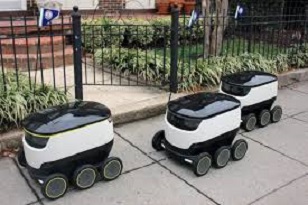
So you don’t think governments and robots go hand in hand? But they do. One state, or should I say commonwealth, proves it. Hence, you have Virginia robots: Knocking on your door.
Virginia is the first state allowing delivery robots to walk the streets. Furthermore, they’ll walk among humans, on their own power. Governor Terry McAuliffe signed the bill into law. But the law takes effect July 1, 2017. We can credit State Congressmen Ron Villanueva and State Senator Bill DeStaph, both from Virginia Beach, for pushing this law. We can also thank robotic company Starship Technologies for promoting this law.
However, Virginia robots must follow the law. Their speed limit is 10 miles per hour. They can carry up to 50 pounds. But these robots do have freedoms. Robots can only cross at crosswalks. That law applies to humans too. And you know how we are. When it comes between humans and robots, the robots have the right-a-way. Cities and towns can regulate these Virginia robots any way they please. Starship isn’t the only one pushing for these walking bots. Food delivery service app Grubhub, and online retail giant Amazon, sent letters saying this is a good idea. You know it’s not going to stop in Virginia.
Starship Technologies tests robots in Washington, DC and Northern California. Furthermore, Idaho and Florida debate walking robots being allowed to deliver goods. Also, other companies want to. So this could be the newest tech trend. It doesn’t surprise me. Yes, our IT support?industry is changing. But is if for the better? Yes, it could boost the delivery industry. And it could get your food there faster. However, there are worries. Any computer repair expert can tell you technology can go horribly wrong. So can these robots. And what about the social and economic ramifications? Already, they replace fast food workers with robots. Will these robots do the same to food delivery workers? If a robot knocks on your door, would you answer?

Mar 2, 2017 | Uncategorized, youtube
Millions tune to You Tube every day. It’s almost as popular as television and/or streaming networks. But can you imagine You Tube cable TV? Consequently, you don’t have to imagine it anymore. You Tube cable TV becomes reality.
So Tuesday, You Tube introduced You Tube TV. For $35 a month, they will package and deliver streaming channels to your Internet. Then there’s the cloud that lets you skip ads. I’m sure that’s a selling point. But here’s good news and bad news. Good news: You’ll get the big four: NBC, CBS, ABC, and FOX. You’ll also get 40 other channels, including ESPN (sports lovers rejoice!) However, there’s bad news. We may or may not have HBO, TBS, Discovery, or Comedy Central. Negotiations are ongoing.
Furthermore, there’s a lot of competition out there. Hence, you have Verizon and Comcast and Dish Satellite. But you also have Sony’s Vue and Hulu. Plus, some streaming services aren’t looking so good. They’re having technical difficulties. And they’re not the only ones. Meanwhile, You Tube seems to have it’s act together. Their technical difficulties are usually minor and minimum. Also, they’re good at videos, online and live ones. The 12-year-old record speaks for itself. I don’t know when You Tube cable TV’s debut will be.
But I do know it faces an uphill battle: price. I doubt $35 a month will make that much of a profit. But then again, that will be another huge selling point. People are tired of paying expensive amounts and getting mediocre service. That’s why some networks are among some of the most hated companies in America. I don’t think that will be a problem for You Tube. If You Tube plays their cards right, they will be the most popular streaming service of them all. Just like sports lovers, laptops can now rejoice! And if you need laptops fixed, we can do that for you (I know. It’s a shameless promo, but hey…). So what do you think of You Tube cable TV?

Mar 1, 2017 | News
An American can make a good living in the IT service and IT support industry. But some worry it won’t be for long. In San Francisco, a news story may be confirming our worries. IT workers: Is our industry at risk?
So here’s what’s happening. At the University of San Francisco, 79 IT workers lost their jobs. Furthermore, those jobs are going to an farm owned by India. The IT workers found out Tuesday, Feb. 28. Also, they’re not being quiet about it. Their spokesperson, Bob Zhang, complained companies and universities do this to replace high paying jobs. They also use the H-1B visa program to send jobs to foreign workers, according to Zhang.
Here’s another reason these layoffs make news. It’s rare for a university to outsource jobs. The now unemployed IT workers picket and try to retain their jobs. However, they are unsuccessful. Consequently, the U-San Francisco discussed Zhang’s complaints. They said the layoffs will save the university over $33 million. They also said the school needs to save as much money as they can to fight rising costs. But that’s little comfort or excuse to these workers. Kurt Ho, a former IT employee, said he made $110,000 a year with U-San Francisco. He said the workers on this farm will make a fraction of that.
But it’s not just the universities that worry. It workers seem to be struck on both sides. Not only are IT workers losing their jobs to robots, and overseas, but to those who will take them for far less. Keep in mind some of these former employees are in their 50s and 60s. Do you know how hard it is for someone of that age to get a new job? And you’re not going to convince me they’re not enough tech based jobs for everyone. No university should be snatching jobs from one group ?and give it to others. You have 79 people whose lives are now on the line. And for what? So the university can save a little bit of money? That’s not right. Will this be a national trend?

Feb 28, 2017 | Uncategorized
I read an interesting statistic. Around 77% of Americans now own a smartphone in 2017. In 2011, just 35% of Americans of Americans had smartphones. But some say this isn’t good. Furthermore, others say the smartphone will be dead in five years. Is the smartphone dying? Some experts think so.
So, some argue smartphone makers are running out of new ideas. Hence, in five years, there will be no more innovation. Think about it. Smartphones can do almost everything today. We can watch TV. We can also listen to radio and take pictures. Furthermore we depend on smartphones to work, rest, and play. So is the smartphone dying?
Some believe voice technology and AI will replace the smartphone, at least in innovation. Over one in four Americans use voice technology at least once a week. Also, voice is the top way to control many tech devices, from smartphones to big screen TVs. Look at how popular items like Google Home and Amazon Echo are. I predict that in the years to come, they will integrate voice in all things technology. I can see how critical it would be to VR machines. So if voice technology is the next big thing, then why would we need a smartphone?
Um…not so fast. In the 1950s, when TV came out, they said the radio was dead. Yet we still listen to radio today. In the 2000s, as Internet entered the social media era, many believed it was the death of TV. But that’s not right, either. Is the smartphone dying? I doubt it. I believe just like radio and TV, people will need their phones for decades to come. If anything, they will use smartphones in a different capacity. But voice technology can only do so much. So in decades to come, at our Boston computer service shop, we’ll still be fixing smartphones. Sorry, but I don’t see the smartphone going anywhere anytime soon. But I’ll ask you…Is the smartphone dying?

Feb 27, 2017 | General
Nobody is immune to the troubles of today’s world. Hence, not even those in computer repair and IT support. No, not even tech billionaires and leaders. In fact, many of them already flee a potential tech apocalypse.
So as I write this, there are tech billionaires and Silicon Valley leaders buying land in New Zealand. PayPal founder Peter Thiel is one of the main tech leaders. He bought a 477-acre estate in New Zealand’s Southern Alps region. Furthermore, this estate costs him $10 million. Billionaire hedge fund investor Julian Robertson has land in New Zeland. Reddit co-founder Steve Huffman had laser eye surgery. He believes when the apocalypse comes, there will be no glasses. Then we have former Yahoo exec Marvin Laio. He stocks up on archery and guns to protect his family. And why is Elon Musk so desperate to build colonies on Mars?
In fact, half of all Silicon Valley leaders took out ‘apocalypse insurance’. They’re using this coverage to build a refuge at home and/or find one overseas. So a better question is: Why are they prepping? Many fear a human backlash when robots/AI intelligence takes all the human jobs. ?Some worry about these robots turning on humans altogether. Now that’s a tech apocalypse. Others fear that if the bottom falls out, mobs of the 99% will hunt the super-rich and rob them of everything they have.
And there are other worries. So these include threats of nuclear war, climate change, asteroids/meteorites, radiation, rising racial tensions, increasing political divisions, wealth inequality, civil unrest, and terrorism from groups like ISIS. All of this is happening right before our eyes. Some laugh at this. Others say they’re taking it way too far. But are they onto something? Nearly a quarter of Americans believe the End of Days will happen in their lifetime. Unrest isn’t just in America. In Romania, there were clashes between the police and the masses. Then in France, riots erupted after a handful of officers beat and sodomized a black man. In Germany, someone drove a car into a crowd. Four times in 2017, an asteroid barely missed planet Earth. So are these tech billionaires right? Should we be concerned about a tech apocalypse?
