
May 3, 2015 | News
The Silicon Valley suddenly lost a legend this weekend. Survey Monkey CEO David Goldberg passed away suddenly Friday night, May 1, 2015. The cause is not yet known. David Goldberg was only 47 years old.
David Goldberg’s death was announced on Facebook Friday night by his brother Robert. David Goldberg was the husband of Facebook COO Sheryl Sandberg. The couple raised two children together. Goldberg will be remembered as one of the most successful entrepreneurs in Silicon Valley, and one of the most likable. Mr. Goldberg was raised in Minneapolis, Minnesota and went on to Harvard. He graduated from Harvard in 1989 in history and government. In the years that followed, he worked for Bain & Company, then Capitol Records. In the early 1990s, he started his entrepreneurial career when he and a friend from high school started Launch Media, a digital magazine company. ?In 2001, Yahoo bought Launch Media. He went on to serve as head of Yahoo Music. Around this time, he began dating, and eventually married Sheryl Sandberg. Sandberg eventually became one of the most powerful women in the world. In 2007, Goldberg left his lucrative position at Yahoo and became entrepreneur in chief at Benchmark Capital. In 2009, he became the CEO of Survey Monkey. There, he turned a struggling online survey company into a successful $2 billion dollar powerhouse.
But what made David Goldberg so likable was the way he treated others, and the dedicated family man he was. No matter how busy he and his wife were, they always made time for their kids. They were both home between 6-8 pm, and nobody was going to interfere in that. In a world where most insist on success and perfection, he believed in giving employees opportunity to fail and let them learn from failure. When most looked for the most experienced, Goldberg took chances on many fresh out of business school. In an era of conglomerate merger and takeover, Goldberg embraced a small business environment. In just a few years, that formula took a struggling company with 14 employees to a successful one with 500 employees, creating over 25 million surveys. Our thoughts and prayers go out to Mr. Goldberg’s family, friends, colleagues, and employees during this difficult time. We here at Geek Choice invite you to chime in and tell us what lessons can we learn from Mr. Goldberg’s legacy?

May 2, 2015 | Wireless
On my social media page, I have a friend who is very excited because he got his Apple Watch. I hope he doesn’t have tattoos on his wrists.
Apple just confirmed that in layman’s terms, tattoo and iWatch don’t mix. Complaints are pouring in about the watches’ failure to read heartbeats and even failure to detect skin contact at all on heavily tattooed wrists. According to Apple’s own statement, changes to your skin (hint hint…tattoos) can alter heart rate monitor performance. Some ink and tattoo art can block light and make readings difficult. Not all tattoos are affected. Tattoo colors having the biggest clashes with the iWatch ?are black, red, and other dark inks. And some people with body art are having no problems whatsoever. If you’re having tattoo problems, it’s been suggested you turn off wrist detection in the companion app. But if you do that, you shut down the watch’s access to Apple Pay. I’ve read that when people cover it up, the watch works perfectly. And you could always wear a chest based heart rate monitor with Bluetooth connectivity, but that would be worst case scenario.
Since I was a kid, I’ve always been afraid of needles. Even getting a flu shot was about as scary as a root canal. That’s why I never got a tattoo. So Apple Watch needs to do better by those who don’t have the same fear. I don’t know how many complaints Apple has received because of this issue. But I do know many, many people are excited about Apple watch. And I do know more people are getting body art on more body parts, like the wrist. And to have complaints about malfunctions now is the last thing Apple wants. How would you make this right? Are they doing a good job in making it right?
May 1, 2015 | Computer technology
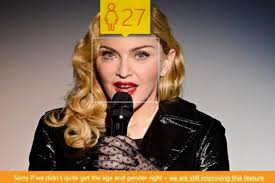
Ever have someone guess your age? How well did they do? Were they exactly right, off a few years, or off an entire generation? Let Microsoft take a guess.
That’s right; Microsoft is building a robot that will take any of your pictures, no matter how or how bad, and try to guess how old you were when the photo was taken. Microsoft had no problem finding volunteers for this experiment. Within hours, tens of thousands rushed to check this app out. At a BUILD conference, the age guessing robot was so popular they could hardly keep the servers up. It works with any photo under 3MB. Note I didn’t say this app was perfect. In fact, it has a long, long way to go. First off, it starting crashing almost as soon as it got hot. That tells me it can’t yet handle the big crowds Microsoft is looking for. They took one photo of an elderly gentlemen and guesses of his age ranged from 7-73. I saw one demonstration on TV this morning. They took a recent photo of Madonna and guessed her age as 27. She’s in her middle 50s. I’ve seen pictures of baby dolls being guessed as aged 2-4. They even got CEO Satya Nadella’s age wrong, by quite a bit. The robot said he is 59. Nadella is really 47.
While they’re making improvements, the Microsoft age guessing app would make a great game. I can see how entertaining it can be to upload a photo and have them guess an age. This could be a hit at parties. The age guessing robot can tell you a bit about yourself. If their age is below yours, you’ve been taking good care of yourself. If the guess is older than you, maybe it’s time to make some changes. But I hope this app it’s just for fun and games. Could facial recognition and age guessing be used for more sinister purposes?

Apr 30, 2015 | General, Uncategorized
We know Jeff Bezos as the CEO of Amazon. We know him for innovations like Kindle, and his lavish, exclusive retreats. But do you know Jeff Bezos as a space man?
He owns a rocket company called Blue Origin. Never heard of it? Most people haven’t. Yesterday, they launched a rocket called Blue Shepard from Blue Origin headquarters in Texas. This company is in the business of private space flight, as in sending regular people into space. Though Bezos talked about the launch earlier this month, not many expected it this soon. The flight must have been a huge success. Blue Origin President Rob Meyerson assures operations are ready for commercial use. From the looks of things, the debut date might be closer than anyone expects. Jeff Bezos himself boasted passengers will have a great journey and smooth return on a space flight. He does admit there were hydraulic issues during decent, and revisions are already being made. The spaceship tested can fly 62 miles above land. It can hold three people. It can’t make a full orbit around the planet, but will do more tests like this before putting humans on board.
That’s a smart move itself. Before you send people into space, make sure your ship is perfect. There is little if any room for error. Neither Blue Origin nor Bezos want tragedy on their hands. My advice to them is test, test, and test some more. Hydraulics ?is just one stumbling block. There’s competition. Virgin Galactic is the first to launch private space airline service. From what I‘m reading, Virgin Galactic seems more organized than Blue Origin. Zero Gravity Corporation offers space flights for as little as $5,000 (Virgin Galactic flights cost $200,000). There’s talk of NASA building colonies on the moon and Mars. So after safety concerns are answered, that’s just the beginning. How will Jeff Bezos and Blue Origin fly in the private spaceship race?

Apr 29, 2015 | Wireless
Like it or not, Uber is growing up. What used to be a controversial mobile transportation app service is now expanding to food delivery and beyond.
When I say beyond, I mean plans for same day merchant delivery. There are plans to train Uber drivers and couriers for a merchant delivery program to get goods from stores to online shoppers in one day. They’re already 400 companies conspiring to make same day Uber delivery a reality. These stores include Neiman Marcus, Louis Vuitton, and Hugo Boss. They’re also allying with mobile shopping app Spring. Yesterday, April 28, 2015, Spring sent emails promoting Spring+Uber services for companies like Big Bang Jewelry, Industry Standard and Outdoor Voices. For a limited time only, these two companies have joined forces to deliver these companies’ goods in a three hour period. But shops like Big Bang Jewelry are a lot less known than a mega corporation like Neiman Marcus. And they have less volume to move around. Eventually, Uber wants to take passengers and merchandise orders at the same time through one app. One spokesperson said, “Experimenting and finding new, creative ways for the Uber app to provide even greater value to our riders and driver partners is a way of life at Uber.”
I respect their quest for expansion, but let’s be cautious about it. While these merchant services were broadcast last summer, I still doubt Uber is ready to take on deliveries from chains like Neiman Marcus and Louis Vuitton. Teaming up with Spring is a great move, but they should keep their focus on the smaller businesses first. If these partnerships are successful, then move on to the bigger more high-end stores. What if they go deliver for the high-end stores, only to find they don’t have the resources or manpower to meet deliveries or consumer demands? What good would that do anybody?

Apr 28, 2015 | Smartphone
Today, Facebook releases a new tool to their ever increasing arsenal, adding to their video power. This tool is free VOIP video calling.
This is what Facebook Messenger is launching over WiFi and cellular connections. This new service is available on all Apple and Android mobile devices. It’s available in 18 countries, including the US, Canada and Mexico. It’s expected to expand to other nations soon. With this feature, two people, even with older, cheaper smartphone devices, can talk to each other anywhere in the world. Facebook has been partners with Skype since 2011, but now continues to craft it’s own video empire. The potential audience is already there. There are 1.44 billion Facebook accounts globally. Forty-one percent of those accounts, 600 million, have access to Facebook Messenger, thus having access to this VOIP feature. Facebook CEO Mark Zuckerburg predicts a day when VOIP will make phone calls look obsolete (like the smartphone and iPod has made the Walkman and Discman obsolete). He wants to be at the forefront of this change. All one has to do is tap the camera icon on Messenger’s top right corner and wait for your recipient to respond. It starts selfie style, but can be manipulated to other angles.
This time, the first 18 nations getting this app will be literally global, from United Kingdom to Oman to Nigeria to Laos to Uruguay. This may not sound like much, but how often do new smartphones and apps go to the wealthiest nations, while others often have to wait months? This is brilliant on Facebook’s part. Now we’ll see if people can keep in touch between New York and Lagos, or Canada and Uruguay with this app. If free VOIP can work in these circumstances, I‘m convinced it can work literally all over the world. But do you really see a day where VOIP will replace telephone calls?

Apr 27, 2015 | Entertainment
Last month, hip-hop mogul Shawn ‘Jay-Z’ Carter launched a streaming music network called Tidal. Tidal has launched criticism ever since. Some have called it, ‘A service for the rich supporting the rich.’ It seems nobody is buying into Tidal. Jay Z took to Twitter and did damage control.
Carter is defiant when he says Tidal is going nowhere. Tweeting under the name Mr. Carter, he reminds critics Tidal has only a part of the revenue that Spotify has, but 75 percent of every dollar Tidal makes goes to the respective artist. Carter says this will give help artists give to their fans over and over again. He tweeted Tidal has only been in business a month, yet it has over 770,000 subscriptions. Rome didn’t grow in a day, neither did Spotify, and neither will Tidal. Carter urges patience and asks fans to give Tidal a chance to grow. Jay Z says Tidal doesn’t just sale music; it sells things like concert tickets and even sporting events. Carter insists Tidal will cut out the middle man and gives more power to artists and less power to the CEOs. Jay Z even bragged about his cousin moving to Nigeria on the search of musical talent and bringing them to the Tidal family.
Shawn Carter does bring valid points. When I read stories about how CEOs and managers ripped off musicians over the decades, it’s heartbreaking. The industry is full of stories where people are millionaires one year and broke and homeless the next year. I’m not saying I’m going to be a Tidal customer anytime soon, but I do respect what he’s doing for the artists. But I’m still not on board with Tidal. I still think fans will pay too much. So far, I haven’t heard Mr. Carter give a good reason why people would pay for what they can often get for free. What will it take for Tidal to make artists and fans happy?

Apr 26, 2015 | email, Security
Last year, President Obama’s email accounts were hacked, as was an unclassified computer system. Now, investigators say that this hack was more severe than first announced.
The Russian hackers also got deep into the State Department’s unclassified computer system. That’s how they got many email archives from people in and out of the White House. Thankfully, no classified information has been compromised. But some of the information they got was sensitive: conversations with ambassadors, potential legislation, policy debates. They got all they needed to learn a lot about the Federal government. What makes this situation even scarier is the culprits seem to be either in the Russian government or hired by the Russian government. Neither the number of these hacks, nor the number of the emails compromised, are known. Investigators call the cyber attack among the most sophisticated they’ve ever seen. This hacking causing debate about President Obama and his aides’ cyber security, despite the President himself taking more precautions, especially emailing outside the White House computer system. But hardly a day goes by when the White House isn’t cyber attacked. Granted most of the attacks are minor, but they still keep coming.
China has also been known to commit hacks on the White House. But what concerns me about the Russian government possibly being behind this is the strained US/Russian relations over the last several years. Obama and Putin have rarely agreed on anything, from the Ukrainian conflict to the handling of Edward Snowden. Some say the relations between these two nations today are just as bad as the Cold War era. Earlier this year, there was a Moscow parade in which a phony missile was paraded with the President’s name on it! Some may say, “You’re overacting; that was probably a joke.” I sure wasn’t laughing. This is why something needs to be done about international hacking. What if Russia knew our secrets? What could that lead to?

Apr 25, 2015 | Computer technology, Wireless
In Switzerland, their national postal service will be conducting an experiment. Instead of a mailman delivering the bills, checks, letters, and junk mail, robots will be filling in.
The Swiss Post will be using drones supplied by Matternet. These experiments are expected to start summer 2015. The first drone they’ll use is called ONE. This drone can deliver over two pounds of mail over 12 miles in one trip. Matternet has already tested drones to deliver medicine to Haiti’s poorest communities and most inaccessible neighborhoods. This drone company leads the world in hours flown and now wants to run three pilots for the Swiss Post. Matternet’s founders, Andres Raptopoulos and Paola Santana, are very excited about the experiment, as well they should be. It’s been their dream to send drones to places that could use them the most. Maybe they have a little too much confidence in Matternet. Raptopoulos is quoted as saying, “Quadcopters may be the biggest invention in vehicle technology since the internal combustible engine.” But then again, when you look at how popular and useful drones are today, Raptopoulos may be onto something.
I applaud Matternet for using drones for when they’re needed and in emergency situations and in times of crises. They’re doing a good job with that in Haiti, where the need is often critical. But how critical is it for mail to be delivered by drones? Will it really hurt us if our letters and small packages keep getting to their destinations the old fashioned way? I think Matternet should focus their efforts on philanthropy work, like what they’re doing in Haiti. There are a lot of places around the world, and even here in America, that can use such services. And what if the experiment is successful? What if nations around the world use Matternet drones? How many potential jobs could that cost?

Apr 24, 2015 | Entertainment, internet, youtube
Happy 10th anniversary, You Tube. Here are my Top Ten You Tube moments. My moments are based on entertainment value, number of hits, and/or impact on the nation and world.
10. 2015 State of the Union: It’s true You Tube delivered this annual address since 2011. But 2015 was the first year interactive features were used to break down President Obama‘s speech. These features are a great step in getting the next generation interested in the political system.
9. Little Girl Is Tired: During the 2012 Presidential Election, a 4-year-old girl cries because she was tired of Barack Obama and Mitt Romney’s campaigning. She said what many adults felt. May God help us all come 2016.
8. Ted Williams Golden Voice: In 2011, this homeless man was discovered on You Tube. He shot up national super-stardom almost instantly, and was given a new life. There’s been some trials along the way. We wish him the very best.
7. 2015 Super Bowl Ads: Now you can see Super Bowl ads on You Tube…before the Super Bowl! This was the first Super Bowl I could fast forward through the commercials and hardly miss a thing!
6. Susan Boyle Discovered: On a 2009 episode of Britain’s Got Talent, 47-year-old Susan Boyle blew Britain away with her singing. This went viral on You Tube, and she blew the world away! This moment turned her into an international icon. Boyle challenged our perceptions, stereotypes, and how we evaluate beauty.
5. Ain’t Nobody Got Time For That: In 2012, Sweet Brown was interviewed after surviving a fire. Who knew this interview would turn into a pop culture phrase and a popular song?
4. Gangnam Style : Since summer 2012, this video has been viewed over 2.3 billion times! Need I say more?
3. Micheal Richards Rant: In November 2006, Micheal ‘Kramer’ Richards went on a racist tirade while performing at a Los Angeles comedy club. The tirade was caught on You Tube and went worldwide, shaming Richards so bad he went on a TV/radio tour to apologize. Richards was the first celebrity disgraced by something caught on You Tube.
2. Justin Beiber discovered: Let me explain this one: In the late 2000s, his mother put up videos of him singing, playing guitar, even playing drums. By late 2009, Hollywood noticed, signed him, and the rest is history. Love him or hate him, the mere fact he was an unknown teenager discovered on You Tube proves this is a new source of discovering talent.
1. Iranian Green Movement: In 2009, then Iranian president?Mahmoud Ahmadinejad won his reelection. Many suspected corruption and took to the streets in protest. Police used batons, sticks, pepper spray, and guns on them. A bystander named Neda Agha-Soltan was shot to death, and it was caught on You Tube and other social media. So were other protests that ended in violence. Thanks to You Tube, the whole world knew the real story of such oppression and injustice in Iran, as renegade journalists and citizens used social media to expose the Iranian government. The Iranian Green Movement proved You Tube can be a voice for the voiceless and a catalyst for change.
Those are my You Tube memories. What are yours?
