
Jun 12, 2016 | Entertainment
Ever watch a TV show set in a city and ask, “How accurate do they portray a certain place? How accurate do they portray an industry?” How accurate does Breaking Bad portray New Mexico? How accurate does Empire portray the hip-hop industry? The question being asked is, “How real is TV show Silicon Valley?
If you ask most, Silicon Valley is scary accurate. Even Snapchat CEO Evan Spiegel says the show is so accurate it’s not a comedy; it’s a documentary. Box co-founder Aaron Levie tweeted, “Good news: it’s accurate. Bad news: it’s accurate.” Was that the goal? Some even guess which character spoofs which Silicon Valley personality. Who would fictional Hooli founder Gavin Belson be? Marc Benioff, Larry Page and Larry Ellison are all viable candidates. And what about his eccentric rival and philosopher Peter Gregory? Could that be PayPal founder Peter Theil? Theil did put his money where his philosophy is. He stood by Hulk Hogan in a very high profile case. Who could Laurie Bream be? On the show, she’s a venture capitalist partner. She’s a woman in a male dominated Silicon Valley world. Maybe this is what makes her extremely cutthroat. Could this either be Mary Meeker, Marissa Meyer, or Ellen Pao? Could Laurie Bream be a combination of all three?
This is what makes Silicon Valley such a hit. Yes, the comedy is very good. But character accuracy is what makes the show relevant. Even real-life tech leaders ask, “Could that be me?” When I watch the show, I’m asking, “Hmmm. Could that be…”. Silicon Valley does a good job portraying personalities. It seems to do a good job integrating tech based events in story lines. It doesn’t blatantly do this. However, they take various issues going on in the tech world today and subtly incorporate them in the show? How accurate do you think this show is? Can you see yourself in Silicon Valley (I mean the TV show)?

Jun 11, 2016 | News
The war between ?Gawker Media and ?Peter Theil/Hulk Hogan is far from over. Gawker was order to pay Hogan $140 million in a civil lawsuit. Hogan got Theil’s help in this victory. But instead of paying, Gawker files for bankruptcy.
The bankruptcy was announced yesterday. Gawker Media’s owner Nick Denton has filed for chapter 11 bankruptcy protection. That’s not all. Denton assures Gawker Media employees they’re going to fight the Theil/Hogan alliance. Gawker vows to fight while staying in business. Gawker’s bank leader Mark Patricof expects high bids while under chapter 11 protection. During the Hogan trial, Denton tried to estimate Gawker Media’s worth. He valued it at between $250-$300 million. That makes me wonder: Did Denton calculate a bankruptcy move regardless of the trial’s outcome? Publisher Ziff Davis put in an offer at $100 million. Ziff Davis owns tech based magazines like PC Mag. This mess all started in 2012. Gawker Media published pieces of a sex tape starring former WWE Champion Hulk Hogan and another man’s wife. Paypal founder Peter Theil financially backed Hogan’s case, paying for his lawyers. Theil believed Hogan’s privacy was violated. Theil also wanted retribution for years of what he called, “…bullying people even when there was no connection with the public interest.”
Denton refuses to apologize or back down. He vows to fight the case and stay in business. This shows me what a dark soul Denton has. I’m not giving Hogan any moral medals here. But to promote a secret tape of a human being’s most intimate moments for profits is inexcusable. If regular people did that, they’d be in jail for sextortion, and rightfully so. But just because he’s running a media company, does that give Gawker Media the right to do it? I’m proud of Peter Theil for taking the side of right, no matter what the motives are. Gawker Media lost the case. Now they’re crying bankrupt. Are they really out of money? Or are they using bankruptcy to get out of paying Hogan his just due?
Jun 10, 2016 | Security
Twitter leaders told users their accounts were at risk. They announced a database with almost 33 million usernames and passwords may be at risk.
Twitter didn’t give the exact number of customers were notified. But it’s believed millions have been notified so far. Millions are changing their passwords. Twitter security officer Michael Coates is confident the database wasn’t stolen from Twitter’s computers. According to LeakedSource, this is more of a consumer issue than a Twitter issue. They believe information was collected from previously hacked computers, not from Twitter’s systems. There’s been an upswing in hacked twitter accounts lately. This week, Mark Zuckerberg’s Twitter account was hacked. So was the National Football League’s. Hackers used that account to play a cruel hoax. That hoax was to announce NFL Commissioner Roger Goodell had died. Don’t worry: Commissioner Goodell is alive and well. ?The year 2016 has been a crazy year for celebrity deaths; I see how this can be believable. A couple of days ago, even Twitter co-founder Even Williams was hacked. According to a German software company, criminals are using Twitter data to hijack the company’s customers. There is a suspicious alias named Tessa88@exploit.im going around. Some, like Hold Security LLC’s Alex Holden, suspect those behind this alias are hacking accounts. Then, they’re reselling the info on the black market.
Holden’s suspicions aren’t that far fetched. Hackers will sale your password and/or username for as little as five dollars. There’s a thriving underground market thriving like that. They don’t care whose information it is. Tech leaders and sports institutions are being hacked. That reminds us nobody is immune. Consumers have to be one step ahead of the hackers, if it’s possible. Don’t make your password too easy. Don’t make your username too easy. Change your password. The more often, the better. What else can we do to keep safe? What can suggest to tech companies to keep us safe?

Jun 9, 2016 | General
In various cities in the USA, Amazon delivers food to it’s customers. Amazon delivers fresh food in the United Kingdom.
Their competitors will be local supermarkets. Not many British tech companies or franchisers deliver groceries. Amazon Fresh offers delivery to over 130,000 homes in the greater London area. These include fresh produce, fresh bakery, and fresh dairy items. This is Amazon Fresh’s first grocery delivery service outside the US. Customers must be British Amazon Prime customers. The service will cost them an additional seven pounds a month (that’s about $10 US). The groceries have to cost over 40 pounds (that’s roughly $58 US). Amazon wants the grocery delivered in one hour of the order. Amazon VP Ajah Kavan is cautiously optimistic. Kavan knows UK has one of the most discriminating customer bases in the world. The bar is extremely high. Local British brand produce will be delivered. So will major global brands like Nestle, Kellogg’s and Coca-Cola. Deliveries will be made in paper-bags and chill-boxes. United Kingdom supermarket chains face pressure from online shoppers and dissatisfied customers. Have you heard the jokes and complaints about British food? British discount stores are doing well. That spells more competition for UK supermarkets. Amazon Fresh delivery services are in two UK cities: London and Manchester. Could it spread?
The supermarket chains better hope not. Amazon Fresh is great for elderly and disabled customers, and their caretakers. These are individuals who could use this service. But what about the rest of the people? Let’s say I were in the UK. Let’s say I were offered Amazon Fresh service. I wouldn’t accept it. That’s because I would want my local supermarket to do well. Yes, there are dissatisfied customers out there. Competition from Amazon Fresh should light a fire under grocers to do better. I hope it does. Besides, London has some of the world’s worst traffic. Good luck getting there in an hour. Besides, don’t we give Amazon enough money already?
Jun 8, 2016 | Computer technology
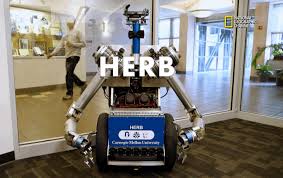
I’ve talked about robots running hotels. I’ve talked about robots nursing patients back to health. Now, we’re introducing HERB the robot. He’ll be tending your butler services.
HERB, or Home Exploring Robot Butler, was built at Carnegie Mellon University in Pittsburgh. This robot is geared to help the elderly and disabled with independent living. HERB will do small task for the resident. This robot can put away books, wash dishes, set a table, clear a table, get food out of the refrigerator, and other daily tasks. Those working on HERB are excited about the human like tendencies.??As we move robots into the home, the robot must be able to operate in much less structured human environments,? said Jennifer King, one of HERB’s creators. As good as HERB is, they want him to do better (I can’t believe I’m calling a robot a him). For example, they want HERB to get food out of the fridge without breaking other items in the fridge. HERB’s software help him navigate such tasks. That’s why HERB isn’t ready to make his public debut. They want to help him be a better servant to other people. In other words, they want him to be more human.
On one hand, it’s a good sale. On the other hand, that’s the scary part. According to this new article, robots could replace half of all jobs by the 2030s. Surely you know about the $15 minimum wage debate. Fast food chain Wendy’s responded. They responded by replacing minimum wage earners with robots and kiosks. Plus, robots will make less errors than humans will. This is the trend I fear. They want to help the disabled and elderly. That’s a noble cause! Wouldn’t it be more noble to give a human being that job and pay him/her a decent wage? And what about those who work in the health care industry? Wouldn’t it be more noble to let human workers work?
